
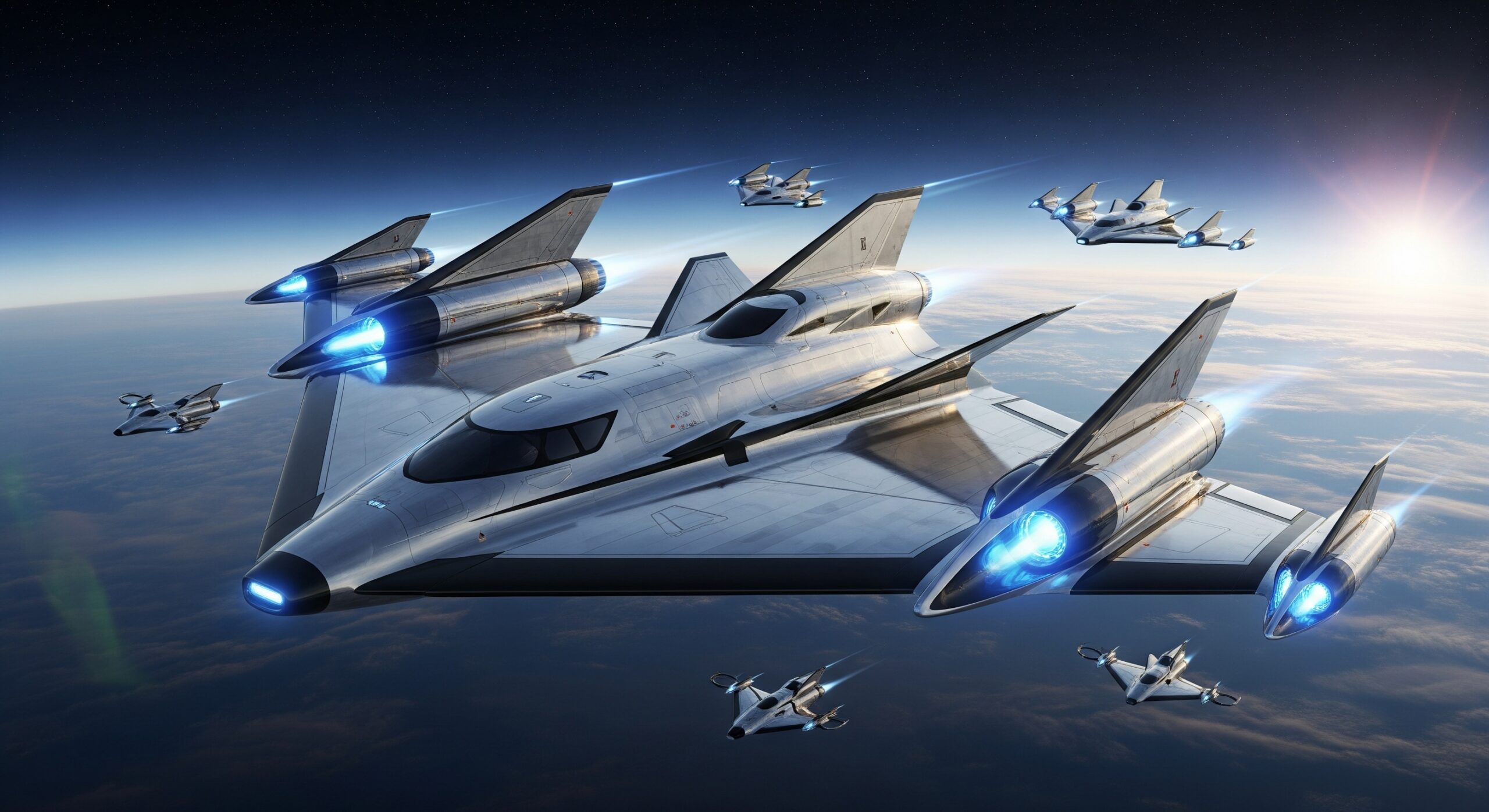
The aerospace industry has always been synonymous with audacity and exploration, constantly pushing the boundaries of what is possible. Today, more than ever, this sector is in the midst of a revolution driven by technological advancements that will not only take us further into space but also transform aviation here on Earth. From ultra-lightweight materials to the artificial intelligence that guides aircraft, we are entering a new era of conquering the sky.
Materials of the Future: Lighter, Stronger, More Efficient
One of the greatest advancements in the aerospace industry lies in the development of new materials. High-tech composites, such as carbon fiber and reinforced polymers, are replacing traditional metals in aircraft construction. These materials are not only incredibly strong but also much lighter, which translates to greater fuel efficiency and a smaller carbon footprint. In addition, additive manufacturing, or 3D printing, is enabling the creation of parts with complex and optimized geometries that were previously impossible to manufacture, reducing costs and production times.
The Propulsion of Tomorrow: Towards Sustainable Flight
Sustainability is one of the biggest challenges for the aviation industry. In response, new propulsion technologies are being developed that promise to revolutionize the way we fly. From electric and hybrid engines to the use of biocombustibles and synthetic fuels, the goal is to drastically reduce greenhouse gas emissions. In the long term, even hypersonic propulsion is being researched, which could dramatically reduce intercontinental travel times.
Artificial Intelligence and Digital Twins: The Data Revolution
The aerospace industry is harnessing the power of data to improve safety, efficiency, and maintenance. Artificial intelligence is being used to optimize flight paths, predict component failures before they occur, and assist pilots in decision-making. In addition, digital twins, exact virtual replicas of aircraft or systems, allow for the simulation and analysis of performance in a virtual environment, which accelerates design and testing, and improves safety.
Space: The New Frontier of Innovation
Aerospace innovation is not limited to commercial aviation. Space exploration is experiencing a renaissance, with increasingly ambitious missions to the Moon, Mars, and beyond. Advancements in rocket propulsion, life support systems, and autonomous robotics are opening up new possibilities for the exploration and colonization of space.
The aerospace industry is at a turning point. Innovations in materials, propulsion, and data management are not only making flying safer and more efficient but are also opening the door to a future where air travel is sustainable and space exploration is an everyday reality. The sky is no longer the limit; it’s just the beginning.