
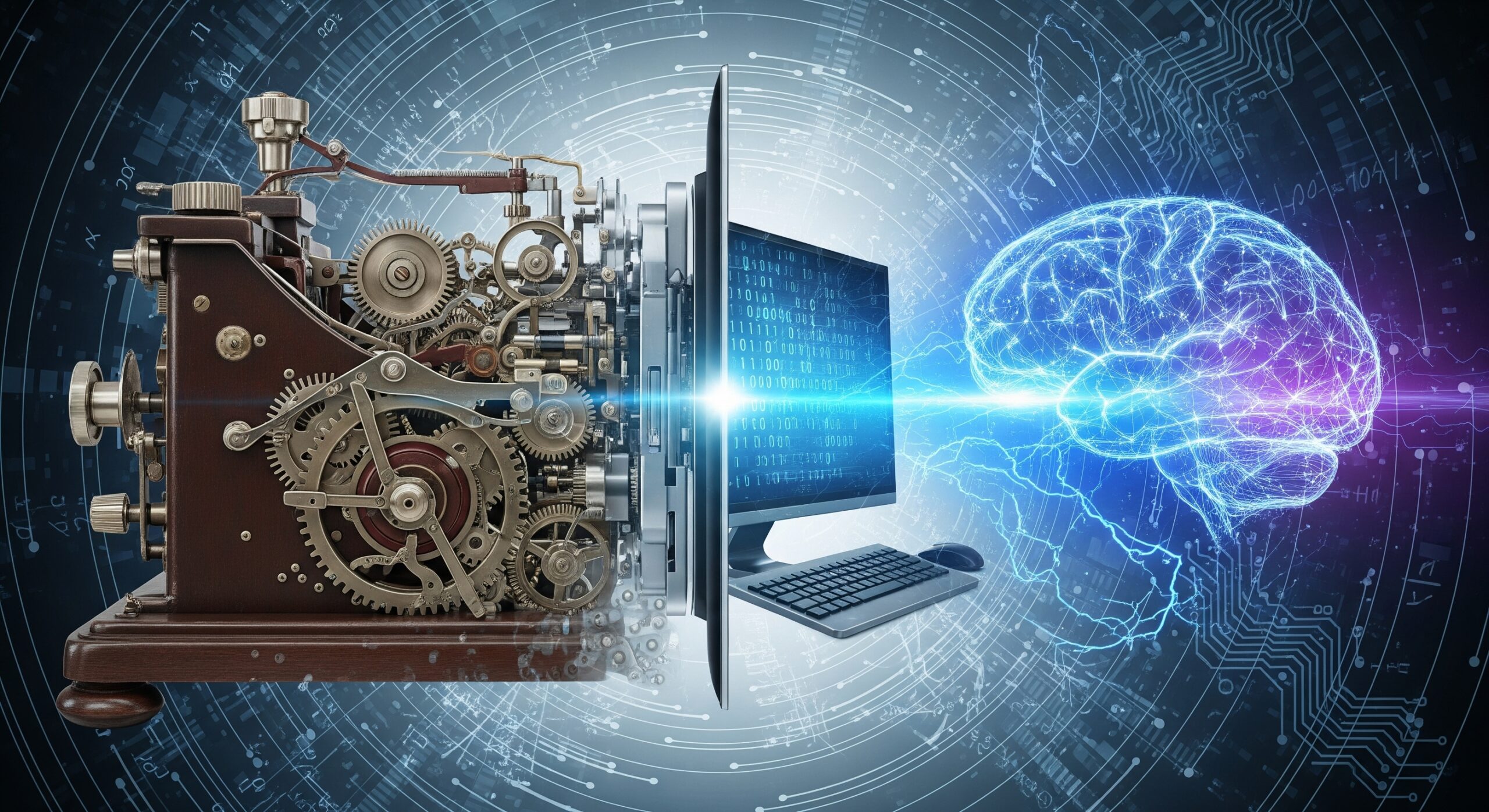
In the history of technological innovation, few individuals cast as long a shadow as Alan Turing. A British mathematician, logician, and computer scientist, Turing’s visionary ideas were so far ahead of their time that their full impact is only now being realized in our age of artificial intelligence. He didn’t just invent a machine; he conceptualized the very essence of what a computer could be, long before the first silicon chip was ever imagined.
The Foundational Concept: The Turing Machine
In 1936, years before the first electronic computers were built, Turing published a paper that introduced a revolutionary abstract concept: the “Universal Computing Machine.” Now known simply as the Turing machine, this was not a physical device but a theoretical one. It imagined a machine that could read symbols on a strip of tape and, based on a set of rules, alter those symbols.
This simple idea was profound. Turing proved that such a machine could simulate the logic of any other computing machine. In essence, he had described the fundamental principles of a general-purpose computer—a single device capable of performing any computable task, from complex mathematics to word processing, simply by changing its program. Every smartphone, laptop, and server in existence today is a physical realization of Turing’s universal machine.
From Theory to Reality: Cracking the Enigma
During World War II, Turing’s theoretical genius was put to the ultimate practical test. As a leading cryptanalyst at Bletchley Park, Britain’s codebreaking center, he spearheaded the effort to decipher the German Enigma code. The Enigma machine generated a seemingly unbreakable cipher, changing its settings daily.
Turing co-developed an electromechanical machine called the “Bombe,” which automated the search for the Enigma’s settings. The Bombe was not a universal computer, but it was a powerful, single-purpose data processing machine. Its success in breaking the Enigma codes is estimated to have shortened the war by several years, saving countless lives and directly altering the course of history.
Asking the Ultimate Question: “Can Machines Think?”
After the war, Turing’s work continued to push boundaries. He contributed to the design of some of the first programmable electronic computers. But his mind was already on the next frontier: artificial intelligence. In his 1950 paper, “Computing Machinery and Intelligence,” he famously proposed what is now called the “Turing Test.”
The test poses a simple question: Can a machine exhibit intelligent behavior indistinguishable from that of a human? This thought experiment laid the philosophical groundwork for the entire field of AI. Today, as we interact with increasingly sophisticated AI systems, Turing’s question is more relevant than ever.
Alan Turing’s legacy is the digital world we inhabit. He provided the theoretical blueprint for the modern computer and posed the foundational questions that continue to drive the quest for artificial intelligence. He was a true pioneer whose work transformed the 20th century and continues to shape the 21st.