
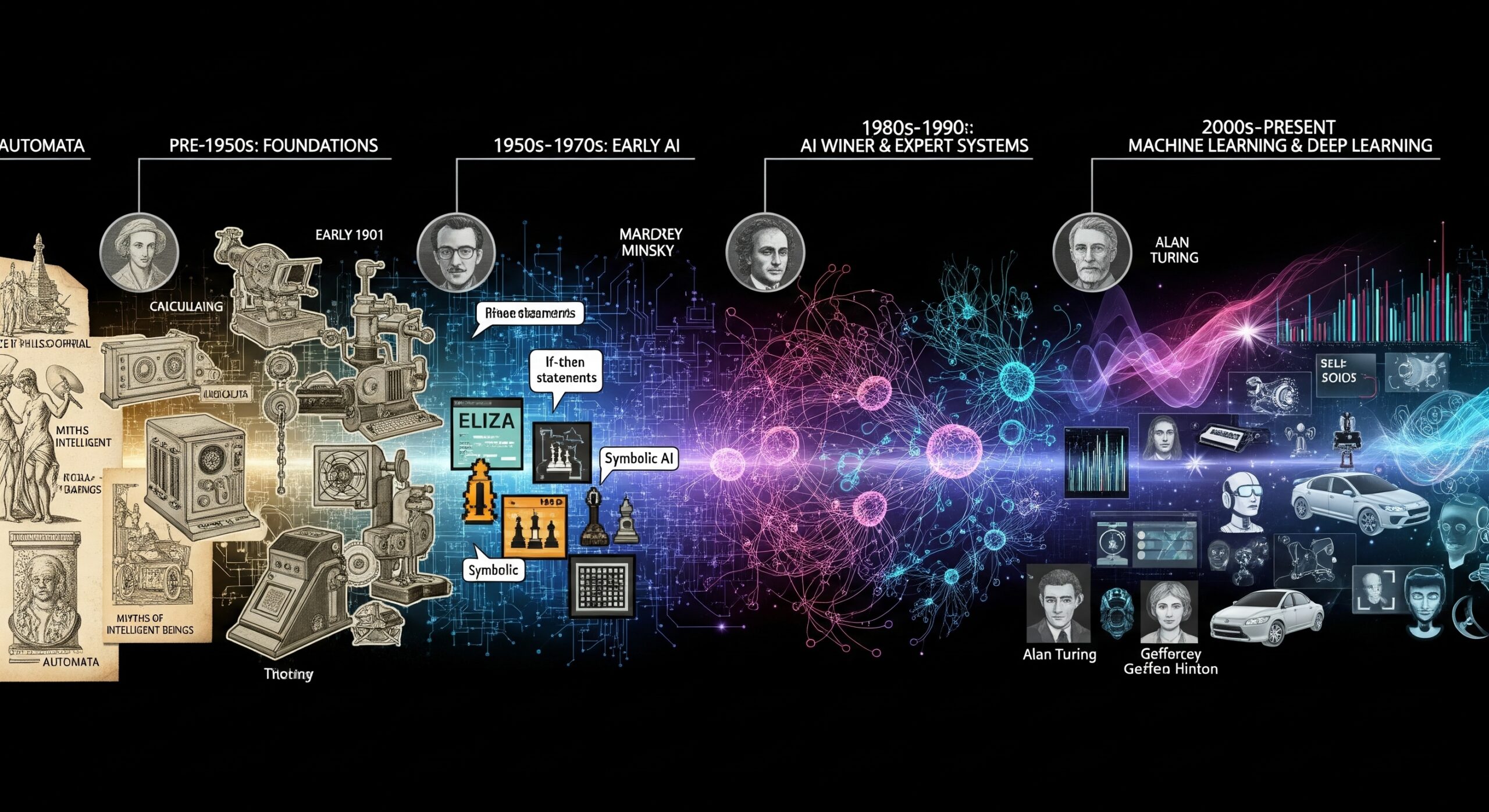
Today, Artificial Intelligence is woven into the fabric of our daily lives, from the algorithms that recommend movies to the complex systems that power self-driving cars. But the concept of AI is not a recent phenomenon. It is a dream as old as civilization itself, a quest that began with myths of artificial beings and has evolved through centuries of philosophical debate and technological breakthroughs. This is the story of how we taught machines to think.
The Seeds of an Idea: From Antiquity to the Dartmouth Workshop
The dream of creating intelligent, non-human entities can be traced back to ancient myths of automatons and mechanical servants. However, the formal journey began with the development of logic and mathematical reasoning. The true birth of AI as a scientific field, however, is widely credited to a workshop held at Dartmouth College in the summer of 1956. It was here that the term “artificial intelligence” was coined, and a group of pioneering researchers gathered with an audacious goal: to create machines that could learn, reason, and solve problems like humans. The optimism was boundless, with many predicting that a machine as intelligent as a human was only a generation away.
The “AI Winters”: Cycles of Hype and Disappointment
The early days of AI were marked by significant, albeit limited, successes. Programs were developed that could solve algebra problems, prove logical theorems, and play games like checkers. This early progress, however, led to an overestimation of the challenge. The sheer complexity of human intelligence and the limitations of computing power at the time meant that the lofty promises of the field’s founders were not met.
This led to periods known as “AI winters.” Funding dried up as governments and investors grew disillusioned with the slow pace of progress. The initial excitement gave way to skepticism, and the field of AI, for a time, was pushed to the academic periphery.
The Rebirth: Big Data, Neural Networks, and Deep Learning
The turn of the 21st century brought a perfect storm of conditions that would lead to an AI renaissance. The explosion of the internet created vast amounts of data (“big data”) to train AI systems. Simultaneously, Moore’s Law had delivered exponential increases in computing power, making it possible to process this data on a massive scale.
This led to the resurgence of a technique inspired by the human brain: neural networks. With enough data and computing power, these multi-layered networks could be trained to recognize patterns with incredible accuracy. This approach, known as “deep learning,” has been the driving force behind the most significant AI breakthroughs of the last decade, from image and speech recognition to the powerful language models that are now capable of generating human-like text.
The Generative Age and Beyond
Today, we are in the era of generative AI, where models can not only understand information but also create original content—text, images, music, and code. This has unlocked a new wave of creativity and productivity, but also raises new questions about the nature of intelligence and the future of human-machine collaboration.
The history of AI is a story of ambition, setbacks, and relentless progress. From a summer workshop’s bold declaration to the powerful AI systems of today, the journey to create intelligent machines has been a long and winding one. And as technology continues to accelerate, one thing is clear: the most transformative chapters of this story are yet to be written.