
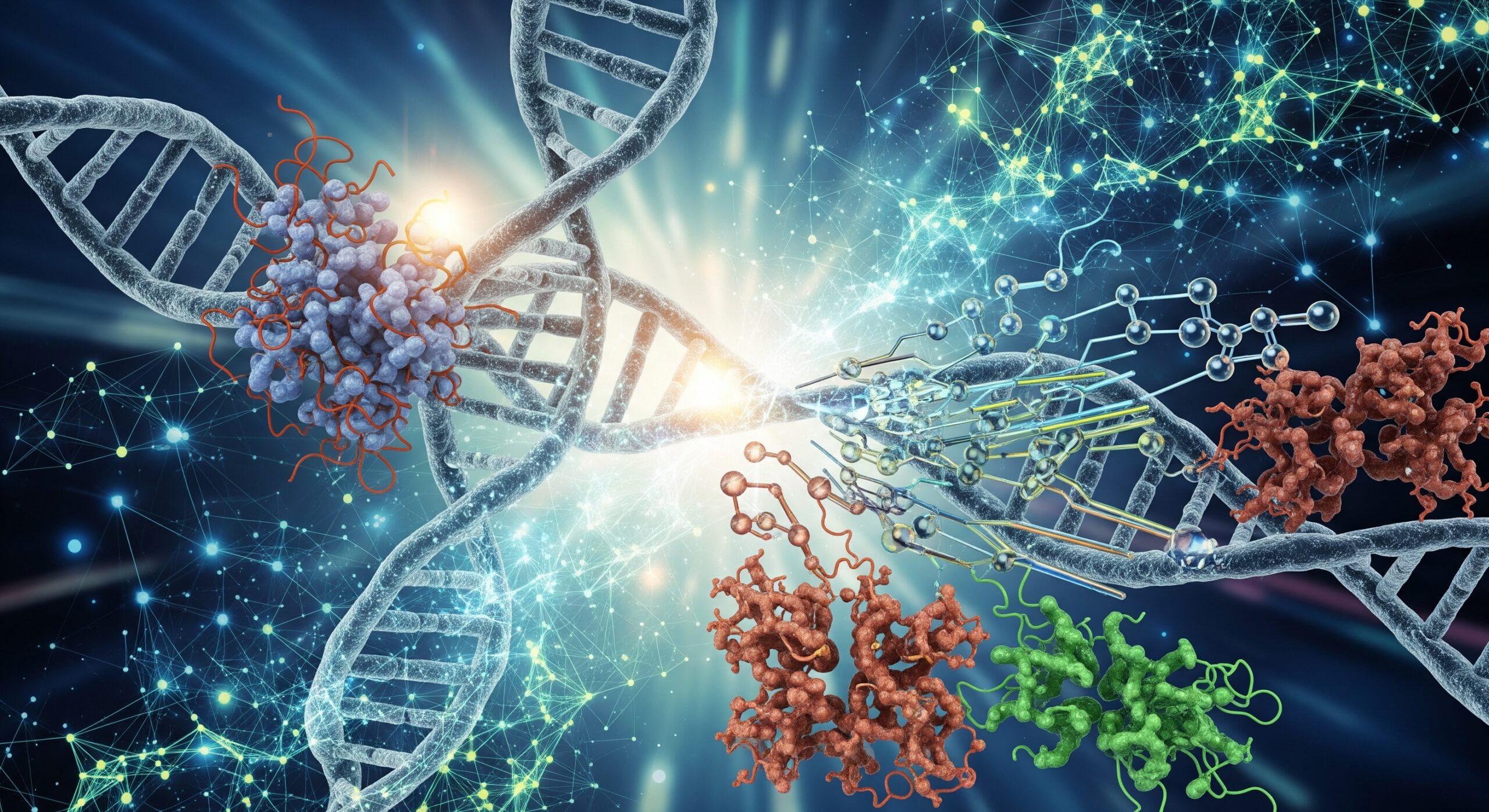
For decades, the process of discovering new medicines has been a monumental task, often taking over a decade and costing billions of dollars. It has been a painstaking process of trial and error, a search for a molecular needle in a cosmic haystack. Today, the convergence of artificial intelligence and biology is triggering a paradigm shift, transforming drug discovery from an art of serendipity into a science of precision and speed.
Predicting Life’s Building Blocks: The Protein Folding Problem
At the core of this revolution is a breakthrough that has been called one of the greatest scientific achievements of our time: solving the protein folding problem. Proteins are the workhorses of life, complex 3D molecules whose shape determines their function. For 50 years, predicting this 3D structure from a protein’s linear amino acid sequence was a “grand challenge” in biology.
AI systems, like Google DeepMind’s AlphaFold, have now cracked this problem with astonishing accuracy. By training on vast databases of known protein structures, these AI models can predict the shape of a protein in minutes, a task that previously could take years of lab work. This is a game-changer for medicine. By understanding the shape of proteins involved in diseases, scientists can design drugs that target them with incredible precision, like a key fitting into a lock.
Generative AI: Designing Drugs from Scratch
Beyond predicting existing structures, the latest wave of generative AI is now being used to design entirely new drugs. In the same way that AI can generate novel text or images, it can now create blueprints for completely new molecules with specific desired properties.
Scientists can instruct an AI model to design a molecule that binds to a specific disease-causing protein, effectively neutralizing it. The AI can then generate thousands of potential drug candidates, far more than could ever be conceived by human chemists. This accelerates the initial phase of drug discovery exponentially, allowing researchers to focus their efforts on the most promising candidates, drastically reducing the time and cost of developing new treatments.
A New Era of Personalized Medicine
The impact of AI extends beyond drug discovery to personalized medicine. By analyzing a patient’s genetic makeup, lifestyle, and medical history, AI algorithms can help doctors predict disease risk and tailor treatments to the individual. This means moving away from a one-size-fits-all approach to a future where medicine is precisely calibrated for each person.
The integration of AI into medicine is more than just an incremental improvement; it is a fundamental transformation. From predicting the intricate dance of proteins to designing novel therapies from the ground up, AI is not just a tool for biologists—it is becoming a digital biologist in its own right, heralding a new era of faster, cheaper, and more effective healthcare for all.